Mallory A. Maurer

Interdisciplinary research assistant with expertise spanning pharmacology, chemistry, genetics, and neuroscience. Currently developing genetic breeding strategies to map modifiers of monogenic diabetes at Vanderbilt University Medical Center. Applying to biomedical engineering PhD programs to help advance drug delivery systems, organ-chips, and biomaterials to improve translational research and patient care.

Current: Cha Lab, Vanderbilt University Medical Center

Previous: Warren Center for Neuroscience Drug Discovery, Vanderbilt University

Mallory A. Maurer

Why Biomedical Engineering?

The Engineering Behind Discovery

Throughout my research career in basic sciences, I've encountered a recurring realization: I'm often more fascinated by the creative, iterative, and design processes that made experiments possible rather than by the results themselves. While my colleagues focused on which compounds showed activity, I found myself captivated by the engineering behind FRET technology, the design of single-cell analysis, and the innovation required to solve technical challenges.

Working at the Warren Center for Neuroscience Drug Discovery, I witnessed firsthand the limitations of traditional drug discovery. No amount of precision chemistry can make a compound target specific tissue or control its release. These aren't problems that can be solved by chemistry alone—they require multidisciplinary engineering solutions.

My interdisciplinary background in chemistry, pharmacology, and molecular biology has prepared me to succeed as a biomedical engineer. Basic science has given me the expertise and firsthand experience to understand what needs to be addressed and how to address it. Now, I want to develop the engineering skillset to design solutions to the problems I have encountered: advancing drug delivery systems to improve therapeutics, designing organ-chips to increase human translation, or create human cell models to accurately study diseases.

Areas of Interest

Drug Delivery Systems

Developing targeted delivery platforms to improve therapeutic efficacy, reduce systemic side effects, and enable personalized medicine approaches.

Organ-on-a-Chip

Designing organ-on-a-chip models that more accurately represent the human body to decrease the need for animal models.

Cellular Engineering

Engineering cell systems and human iPSCs to model disease systems for better understanding and drug development.

Timeline

Education & Experience

Publications

2017 - 2019

University of North Carolina

B.S., Chemistry & Neuroscience

Undergraduate Research Assistant

Cultured primary human colonic epithelial cells in microfluidic models in Dr. Allbritton's Biomedical Engineering lab. Performed immunofluorescent staining and analyzed tight junction integrity.

Jun 2021

First Publication

Integrative Biology • Co-author

Hyperglycemia study using organ-on-chip systems - investigated TNFα effects on colonic epithelial cells

2021 - 2024

Warren Center for Neuroscience Drug Discovery

Research Assistant I • GPCR Pharmacology

Conducted high-throughput screening for neurological disorders. Generated stable cell lines and contributed to compounds entering clinical trials.

2024

Three Publications

ACS Med Chem Lett • J Med Chem

5-MeO-DMT study (co-author)

VU6036864 M5 receptor tool (co-author)

Heteroarylether mGlu5 NAMs (co-author)

2024 - Present

Cha Lab - Vanderbilt University Medical Center

Research Assistant II • Quantitative Genetics

Leading genetic screen using multiomics approaches. Established single-nuclei RNA-seq protocols and analyzing QTL mapping.

2024 - 2025

Biomedical Engineering Coursework

Vanderbilt University • Arizona State University

BME 2100: Biomechanics (A-), BME 2301: Systems Physiology I (A), BME 318: Biomaterials (A+). Final projects included scRNA-seq analysis and decellularization research.

2025

First-Author Manuscript & PhD Applications

In Preparation • Biomedical Engineering

MODY variant research manuscript in preparation. Applying to biomedical engineering PhD programs focused on drug delivery and biomaterials.

Focal Areas

Quantitative Trait Loci Mapping

Vanderbilt University Medical Center | 2024–Present

Leading genetic screen to identify modifiers of MAFA-driven diabetes using forward genetics approaches. Established single-nuclei multiomics protocols and manage complex breeding strategies across multiple genetic backgrounds.

  • Generated and phenotyped 3 genetically modified mouse lines
  • Established single-nuclei RNA-seq and ATAC-seq protocols
  • Analyzed sequencing data using R and MATLAB
  • Collaborated with University of Wisconsin-Madison on QTL analysis
  • First-author manuscript in preparation

GPCR Pharmacology & Drug Discovery

Warren Center for Neuroscience Drug Discovery | 2021–2024

Conducted high-throughput screening campaigns targeting GPCRs for neurological disorders. Generated stable cell lines and performed pharmacological characterization of novel compounds.

  • Established SOPs for calcium mobilization, GIRK, and FRET assays
  • Generated monoclonal stable cell lines in CHO and HEK backgrounds
  • Contributed to compounds entering clinical trials
  • Co-inventor on patent applications
  • Co-author on 6 peer-reviewed publications

Organ-on-Chip Systems

University of North Carolina at Chapel Hill | 2017–2019

Cultured primary human colonic epithelial cells in microfluidic models to study intestinal function and disease mechanisms.

  • Maintained primary human cell cultures
  • Performed immunofluorescent staining and microscopy
  • Analyzed tight junction integrity using ImageJ and MATLAB
  • Co-author on published research in Integrative Biology

Teaching & Mentorship

Vanderbilt University | 2022–Present

Mentored 8 researchers including rotating graduate students, visiting medical students, and undergraduate researchers in laboratory techniques and experimental design.

  • Provided training in molecular biology and animal handling
  • Guided experimental design and data analysis
  • Administrative leadership of multi-lab journal clubs
  • Maintained positive mentoring relationships beyond rotations

Technical Expertise

Molecular Biology

  • Single-nuclei RNA-seq & ATAC-seq
  • RNA extraction & qPCR
  • Immunofluorescence & RNAScope
  • Cell culture (primary & immortalized)
  • Stable cell line generation
  • Western blotting

In Vivo Methods

  • Mouse genetics & breeding strategies
  • Pancreatic islet isolation
  • Oral glucose tolerance testing
  • Tissue harvesting & processing
  • Genotyping & phenotyping

Pharmacology

  • Live-cell calcium mobilization
  • GIRK & FRET assays
  • High-throughput screening
  • Dose-response analysis
  • Receptor pharmacology

Computational Analysis

  • R (single-cell sequencing analysis)
  • MATLAB (image & data analysis)
  • Python (scripting & automation)
  • Statistical analysis
  • Data visualization

Imaging & Microscopy

  • Confocal microscopy
  • Fluorescence imaging
  • ImageJ & Fiji analysis
  • Live-cell imaging

Academic Training

  • BME 318: Biomaterials (ASU)
  • BME 2301: Systems Physiology I (Vanderbilt)
  • BME 2100: Biomechanics (Vanderbilt)
  • Grant writing experience
  • Scientific communication

Posters and Publications

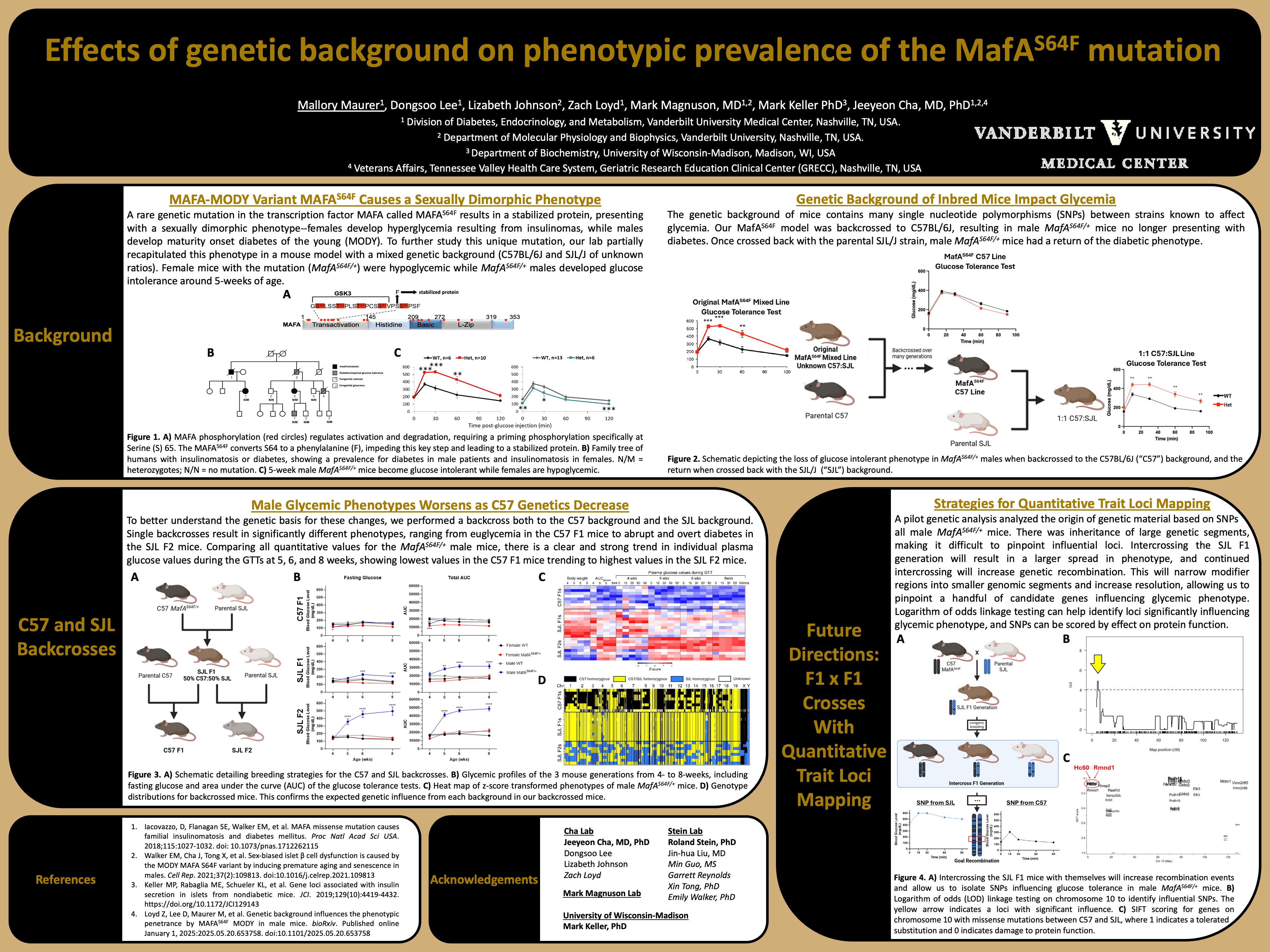
Poster for Vanderbilt Diabetes Day, December 9th, 2025

Effects of genetic background on phenotypic prevalence of the MafAS64F mutation

Click to enlarge image

Publications

Effects of Mouse Genetic Background on the Phenotypic Presentation of MODY Variant MafAS64F
Manuscript in Preparation, 2025

Maurer, M., et al.

First-author manuscript characterizing genetic modifiers of diabetes using QTL mapping and multiomics approaches.

Discovery of 7-(Pyridin-3-yl)thieno[3,2-b]pyridine-5-carboxamides as NAMs of mGlu5
ACS Chemical Neuroscience [Submitted]

Henderson, S.H., Ringuette, A.E., Whomble, D.L., Captstick, R.A., Richardson, A.E., Maurer, M.A., et al.

This study describes the discovery of novel 7-(pyridin-3-yl)thieno[3,2-b]pyridine-5-carboxamides as mGlu5 negative allosteric modulators with enhanced pharmacological properties and selectivity profiles.

Genetic Background Influences the Phenotypic Penetrance by MAFA S64F MODY in Male Mice
bioRxiv [Preprint], 2025 Sep 15

Loyd, Z., Lee, D., Maurer, M., Buzzelli, L., Liu, J.H., et al.

This study demonstrates that genetic background significantly influences the phenotypic presentation of MAFA S64F MODY in male mice, revealing important genetic modifiers of diabetes pathogenesis.

Discovery of Thieno[3,2-b]pyridine-5-carboxamide and 2,3-Difluorobenzamide NAMs of mGlu5
ACS Med Chem Lett, 2025 Apr 22;16(5):865-874

Crocker, K.E., Henderson, S.H., Capstick, R.A., Whomble, D.L., Bender, A.M., Felts, A.S., Han, C., Engers, J.L., Billard, N.B., Maurer, M.A., et al.

This study identified thieno[3,2-b]pyridine-5-carboxamide and 2,3-difluorobenzamide as novel mGlu5 negative allosteric modulators that are highly potent, brain penetrant, and demonstrate improved oral bioavailability.

Discovery of 4-(5-Membered)Heteroarylether-6-methylpicolinamide NAMs of mGlu5
ACS Med Chem Lett, 2024 Nov 18;15(12):2210-2219

Childress, E.S., Capstick, R.A., Crocker, K.E., Ledyard, M.L., Bender, A.M., Maurer, M.A., et al.

This study developed novel mGlu5 negative allosteric modulators by replacing metabolic liabilities with 5-membered heterocycles, identifying VU6043653 as a highly brain penetrant and selective compound with improved pharmacological properties.

Development of VU6036864: A Triazolopyridine-Based High-Quality Antagonist Tool Compound of the M5 Muscarinic Acetylcholine Receptor
J Med Chem, 2024 Aug 22;67(16):14394-14413

Li, J., Orsi, D.L., Engers, J.L., Long, M.F., Capstick, R.A., Maurer, M.A., et al.

This study developed VU6036864, a potent and selective M5 muscarinic acetylcholine receptor antagonist with excellent brain penetration and oral bioavailability, advancing tool compounds for neurological research.

Evaluation of the Indazole Analogs of 5-MeO-DMT and Related Tryptamines as Serotonin Receptor 2 Agonists
ACS Med Chem Lett, 2024 Jan 19;15(2):302-309

Jayakodiarachchi, N., Maurer, M.A., Schultz, D.C., Dodd, C.J., Thompson Gray, A., et al.

This study synthesized and characterized novel indazole analogs of 5-MeO-DMT as potent serotonin receptor 2 agonists, examining their 5-HT2 pharmacology with emphasis on subtype selectivity.

Hyperglycemia Minimally Alters Primary Self-Renewing Human Colonic Epithelial Cells while TNFα Promotes Severe Intestinal Epithelial Dysfunction
Integr Biol (Camb), 2021 Jun 15;13(6):139-152

Dutton, J.S., Hinman, S.S., Kim, R., Attayek, P.J., Maurer, M., Sims, C.S., Allbritton, N.L.

This study investigated the effects of hyperglycemia and TNFα on primary human colonic epithelial cells, finding that TNFα was the dominant modulator of epithelial dysfunction compared to glucose levels.

Contact

Email: Mallory.A.Maurer@gmail.com

LinkedIn: linkedin.com/in/mallory-maurer-25b1a3229